End-to-End B2B Solutions Reducing Operational Costs and Accelerating Profitability


End-to-End B2B Solutions Reducing Operational Costs and Accelerating Profitability
From concept to product, make technology the ultimate catalyst for your growth. Our SaaS MVP development solutions are specifically architected for both high-growth startups and established enterprises. Regardless of your growth stage, we empower you to secure an unshakeable competitive advantage on a rock-solid, zero-technical-debt foundation.
We help startups accelerate time-to-market, validate core hypotheses rapidly, and iterate strategically. We deliver a growth engine: investor-ready, commercially viable MVPs that prove market demand.

We eliminate enterprise friction and organizational inertia, accelerating your innovation initiatives with zero operational risk. We engineer scalable MVPs built around enterprise-grade data privacy and sovereignty—fully compliant with industry regulations and seamlessly scaling with your existing enterprise systems.
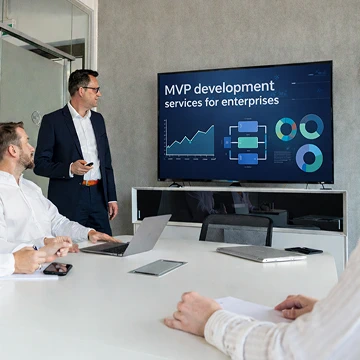
Cognitime Tech delivers a comprehensive suite of end-to-end SaaS MVP development solutions, led by senior software architects and the autonomous power of AI-augmented engineering.
From initial concept to production release, we provide end-to-end custom SaaS MVP development that transforms complex business requirements into resilient, revenue-generating, multi-tenant solutions.

We harness AI engineering tools and autonomous workflows to accelerate SaaS MVP delivery. Guided by our spec-driven development approach, we build a clean, scalable, and maintainable code architecture.

Deep enterprise software architecture experience turned into your competitive edge. We help analyze the market, prioritize features, create prototypes, and meticulously plan every development step.

Our rapid SaaS MVP methodology combines focused scope management, intelligent tooling, and continuous validation. We accelerate time-to-market without compromising architectural quality or security.

For early market validation and rapid Proof of Concept (PoC) initiatives, we architect enterprise-grade low-code and no-code platforms with strict engineering discipline—supporting complex business logic, automated workflows, and seamless third-party integrations.

Once your MVP proves product-market fit, we engineer your scale. We add advanced capabilities, optimize performance, scale infrastructure, and harden security to evolve your MVP into full-scale enterprise software.

Cognitime Tech is your strategic engineering partner in transforming ambitious product visions into commercially viable, scalable SaaS architectures. Leveraging deep enterprise software expertise, we build high-performance SaaS MVPs free of technical debt.
We accelerate your delivery timelines without compromising architectural quality or security. Our engineers leverage reusable modular libraries, enterprise-grade boilerplates, infrastructure templates, and AI accelerators to take your MVP live rapidly.

From feature scoping to MVP maintenance, we support your SaaS MVP initiatives from start to finish. We eliminate the operational overhead and communication silos of multi-vendor management—managing the entire development lifecycle under one roof to maximize your time and budget efficiency.

An MVP is only the opening move. To safeguard your long-term success, we prioritize scalability and extensibility from day one—supporting every iteration and strategic pivot so your platform scales effortlessly alongside your business.

Transparent communication and deep alignment with your team set us apart from day one. Moving beyond transactional vendor relationships, we invest in long-term strategic partnerships and engineer solutions that directly serve your commercial objectives.

Start focused. Validate fast. Scale seamlessly. Leverage our deep enterprise software architecture expertise.
Work directly with senior software architects; let's build your SaaS product to scale seamlessly with your business.
We follow a strictly project-driven approach—working across all major programming languages and frameworks to select the optimal stack for your product's specific requirements, while leveraging a broad suite of AI-augmented engineering and acceleration tools to bring your MVP to market significantly faster.
























SaaS MVP development transforms your technology investment from a cost center into a revenue-generating growth engine for your business.
Data-Driven Decisions. Shape your product direction with real market insights and live user feedback rather than assumptions.
De-Risked Investment. Validate your business hypotheses in a controlled environment before committing capital to full-scale development.
Maximum Budget Efficiency. Identify what your users truly need and build strictly high-impact core features—zero wasted spend.
Faster Time-to-Market. Launch within weeks and capture critical early-adopter telemetry to fuel future iterations.
Higher Code Quality & Early Defect Prevention. Validate core functionality early and resolve technical bottlenecks before they become expensive at scale.
Clear Product Roadmap. Turn validated user insights into an execution-ready roadmap for long-term commercial growth.
SaaS (Software-as-a-Service) is a delivery model where users access cloud-hosted software over the internet via subscription. SaaS MVP development is the engineering process of building a Minimum Viable Product for a SaaS application—delivering core value with lean, scalable architecture.
Rather than spending months or years building a full-scale solution in the dark, companies build SaaS MVPs to validate business hypotheses with real users, prove market demand, and iterate based on live insights before committing to full-scale investment.
While the core goal remains the same—launching a lean version rapidly to validate real-world value—SaaS MVPs require critical foundational components from day one. Because SaaS products are delivered online as a continuous service rather than a one-time installation, they typically demand multi-tenant architecture, subscription billing management, role-based access control, and scalable cloud deployment.
Virtually any B2B or B2C cloud software can launch as an MVP—including CRMs, project management suites, design platforms, video conferencing solutions, HRTech, FinTech, and MarTech tools.
When selecting an engineering partner for your SaaS MVP initiative, focus on three core pillars.
Relevant SaaS Architecture Expertise: Ensure the company specializes in multi-tenant architectures, cloud infrastructure, and subscription models, backed by enterprise-scale SaaS engineering experience.
Broad Technical Mastery & Accelerators: Your partner should have deep expertise across major programming languages, frameworks, and modern cloud solutions suited to your project's needs. Experience with acceleration tools—such as low-code/no-code platforms and AI engineering workflows—is a major advantage for faster launches.
Transparent Communication and Engineering Discipline: Ensure your partner follows structured development workflows and keeps you and your stakeholders fully aligned with clear decisions and regular progress updates throughout the lifecycle.
A specialized SaaS MVP technology partner prioritizes rapid delivery, hypothesis validation, and modular scalability, whereas a traditional development company typically focuses on rigid, fixed-scope software development from start to finish.
The cost of SaaS MVP development depends primarily on product complexity, target delivery timeline, and team size. For example, a low-code / no-code prototype can be built rapidly (2–4 weeks) by a lean team (1–2 specialists) starting at around $2,500–$5,000. Core MVPs with focused scope and essential integrations range between $5,000–$15,000, while more complex standard and enterprise MVPs range from $15,000 to $60,000+.
Depending on product complexity and team allocation, SaaS MVP development typically takes anywhere from 2–4 weeks to 4–6 months. You can review the SaaS MVP Development Costs & Timelines table above for a breakdown by tier, or reach out via our contact links for a tailored architectural assessment and exact quote.
With our project-driven, tech-agnostic engineering approach, we command a comprehensive technology ecosystem capable of building SaaS MVPs of any scale or complexity. From Go, Python, Rust, Java, Node.js, TypeScript, React, and Vue.js to modern cloud platforms (AWS, Google Cloud, Azure) and AI engineering tools (Claude, Cursor, Copilot), we select the optimal stack tailored to your project's specific needs, long-term scalability, and multi-tenant security.
